The Great Crises
Rebuilt From the Roots: How American Vines Saved Bordeaux
After phylloxera, Bordeaux was replanted vine by vine on American rootstock. The dead ends, the grafting debate, and the 41B that beat limestone chlorosis.
The phylloxera aphid was never cured. That is the fact from which the whole of what followed hangs. Once it was understood that the insect could not be poisoned out of the soil, the French vineyard faced a choice with no comfortable option: abandon the vines, or rebuild them, root by root, on foundations the aphid could not destroy. Bordeaux chose to rebuild — and the rebuilding, which historians call the reconstitution, was the largest agricultural undertaking the region had ever attempted. It remade not only how the vines grew but which vines were grown, and the vineyard that stands in the Gironde today is in almost every row its product.
The dead ends
Before grafting won, growers spent two decades on remedies that did not. Each worked somewhere, for someone, which is exactly why the argument lasted so long.
The most credible chemical answer was carbon disulfide (sulfure de carbone), a volatile liquid injected into the soil to gas the aphid at the root, its use championed by Baron Paul Thénard. It killed phylloxera where it was applied well — but only in the most open, fertile soils, and it demanded equipment, chemical and labour that priced most growers out. A related compound, potassium sulfocarbonate, offered a gentler version of the same idea and the same limits. Submersion — flooding a vineyard for weeks each winter to drown the insect — genuinely worked, but only on flat, low-lying land near enough to a water source to be inundated on command, a small fraction of the Gironde. And it was noticed that vines grown in deep sand were simply left alone, the aphid unable to move through the loose grains; but you cannot move a vineyard onto sand it does not have. Three real remedies, each shackled to a soil or a site most vineyards did not possess. None of them could reconstitute Bordeaux.
The américanistes
The answer that could came from the group the trade nicknamed the américanistes. Their insight was that the aphid had come from North America aboard American vines — and that those same American vines, having evolved alongside phylloxera for millions of years, survived it. If the productive but defenceless European vine, Vitis vinifera, could be joined to an American root, the plant might keep its European fruit and gain American resistance below ground.
The idea took shape around Montpellier. In July 1868 the region's agricultural society appointed a three-man commission to investigate the dying vineyards: the grower and society president Gaston Bazille, the botanist Jules-Émile Planchon, and the winegrower Félix Sahut. It was Planchon, working with the American entomologist Charles Valentine Riley — who knew the aphid from Missouri and knew which American vines shrugged it off — who carried the grafting solution forward, travelling to the United States in 1873 to see the resistant vines in the ground. Bazille and the grower Léo Laliman had independently floated the same proposal: graft French tops onto American roots. The French government, desperate, had posted a prize of more than 300,000 francs for a cure; Laliman tried to claim it and was refused, on the grounds that he had not cured the blight but only found a way around it — a distinction that captures the whole tragedy of the reconstitution, which saved the vineyard without ever defeating the insect.
The américanistes did not win by decree. They won at congress after congress — notably the international phylloxera congress held at Montpellier in 1874, where grafted American-rooted vines were shown bearing European fruit — and against real resistance from growers who distrusted the foreign roots and from chemists who kept faith with carbon disulfide. But the arithmetic was merciless. Chemicals bought time on a minority of sites; grafting offered every grower a vineyard that would live.
Graft, or start over?
Even among those who accepted American roots, a second argument opened. One path was grafting: keep the classic European varieties exactly as they were and set them, one scion at a time, onto an American rootstock. The other was to replant with direct producers (producteurs directs) — new hybrid vines, crossings of European and American species, that carried their own resistance and could be grown on their own roots, with no grafting at all. The hybrids were cheaper, hardier and simpler; at their peak in the first half of the twentieth century they covered close to a third of France's vineyard.
But they made wine the trade judged coarse, and in a region that sold on reputation that judgement was fatal. Bordeaux, like the other fine-wine regions, came down on the side of grafting: the extra cost was the price of keeping Cabernet, Merlot and the rest unchanged in the glass. The hybrids were pushed to the vineyard's margins and eventually out of quality production altogether. The decision fixed the shape of French viticulture for a century — noble varieties above ground, American resistance below, joined at the graft.
The chlorosis problem — and 41B
Choosing to graft only raised the next question: onto what? The earliest American rootstocks, drawn from Vitis riparia and Vitis rupestris, resisted phylloxera well but carried a hidden flaw for Bordeaux. On the limestone soils that underlie much of the right bank — Saint-Émilion, Pomerol and the côtes — these roots suffered lime-induced chlorosis: the active calcium carbonate locked up the iron the vine needed, starving the leaves until they yellowed and the plant failed. A rootstock that died of the soil was no better than a vine that died of the aphid.
The escape came from a third American species, Vitis berlandieri, native to the limestone hill country of Texas and naturally at home on chalk — some of the vines put to work in France were collected and sent over by the Texan horticulturist Thomas Volney Munson, whom a grateful French government decorated with the Mérite Agricole in 1888. Berlandieri resisted both the aphid and the lime, but was hard to root and graft on its own, so breeders crossed it. In Bordeaux in 1882, Alexis Millardet and Charles de Grasset produced a cross of the vinifera Chasselas with berlandieri that entered the catalogue as 41 B — a rootstock that tolerates up to about 40% active limestone and so let growers replant the chalkiest slopes at last. It remains the reference rootstock for limestone across Cognac, Champagne and Bordeaux today. Millardet's name is worth pausing on: the same Bordeaux professor who bred 41 B was the man who, three years later, formalised the copper-and-lime spray as bouillie bordelaise — one scientist answering two of the three plagues at once.
A vineyard remade
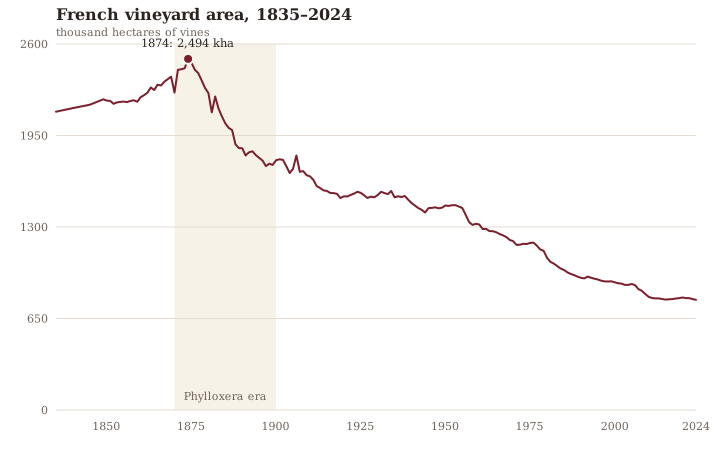
Reconstitution was slow, and it was ruinously expensive. Grafting meant tearing out every living vine and replacing it with a two-part plant that had to be raised, joined and established before it bore a single grape — years of outlay before any return, repeated across every hectare in the Gironde. By 1900 roughly two-thirds of France's vineyard stood on American roots; the recovery of vine area, after the collapse of the 1870s and 1880s, is visible in the long series below.
Because replanting was a once-in-a-generation expense, growers replanted deliberately, and their choices narrowed the vineyard's palette of grape varieties. Varieties that took poorly to grafting fell away. Malbec (locally Côt), long a Bordeaux mainstay, grafted awkwardly and set its fruit unreliably; growers rebuilding at great cost had little appetite for a temperamental vine, and it was steadily replaced by the more dependable and generous Merlot, which grafted well and today is the most planted grape in Bordeaux. The reconstitution did not decide the region's varietal hierarchy single-handed — later blows, such as the catastrophic frost of 1956, finished what it began — but it set the direction. The vineyard that emerged was tidier, more uniform, built on fewer varieties and on roots from another continent. It had survived. It was simply no longer the same vineyard.
Sources
- Gilbert Garrier, Le Phylloxéra — une guerre de trente ans, 1870–1900 (Albin Michel, 1989, ISBN 2-226-03879-5)
- Great French Wine Blight — Wikipedia (Montpellier commission, Riley, Laliman, the government prize)
- 41 B Millardet et de Grasset — Plantgrape (IFV/INRAE), on parentage and active-limestone tolerance
- Pierre-Marie-Alexis Millardet — Wikipedia (Bordeaux professor, rootstock breeding and Bordeaux mixture)
- Thomas Volney Munson — Wikipedia (Texas Vitis berlandieri, Mérite Agricole 1888)
- Anderson & Pinilla, Annual Database of Global Wine Markets, University of Adelaide