Themes
The Grapes of Bordeaux: Two Thousand Years of Changing Varieties (with Data)
From the Roman grape Biturica to a Merlot-dominated vineyard — how the varieties of Bordeaux changed over two thousand years, with modern data.
Ask what grapes Bordeaux grows and you will get a confident modern answer: Merlot and the two Cabernets for the reds, Sémillon and Sauvignon for the whites. It sounds timeless. It is not. The list of varieties planted along the Garonne has been rewritten again and again over two thousand years — by climate, by commerce, by disease and by fashion — and the vineyard of 2022 is not the vineyard of 1850, still less the vineyard of the Roman town. The trouble is that for most of that history nobody counted the vines by name. Only in the last few decades does the record turn into numbers. This article follows the varieties from a grape named after a Celtic tribe to a modern vineyard that can, at last, be charted.
Biturica: the founding grape
The first Bordeaux vineyard belongs to the first century AD, and it grew a single, well-chosen grape. Writing in the 70s AD, Pliny the Elder describes in Book XIV of his Natural History a variety called Biturica — named after the Bituriges Vivisci, the Celtic people who founded Bordeaux. Its virtue was hardiness: it withstood frost, wind and rain, and ripened in the damp Atlantic climate that had defeated the tender vines of the Mediterranean. Ampelographers regard Biturica as a probable ancestor of the Cabernet family — "probable" because the link rests on a chain of names and traits rather than a laboratory pedigree — which would make the grapes that define modern Bordeaux the distant descendants of the one that founded it. That founding story is told in full in The Roman Origins of Bordeaux Wine; what matters here is that the vineyard began with a grape chosen for the climate, and that the choosing never stopped.
The medieval centuries: styles, not varieties
For the thousand years that followed, the record goes quiet on grapes. Medieval documents — customs accounts, sale contracts, monastic surveys — speak of wine by its style and colour, not by its variety. They distinguish clairet, the pale, light red that was the ordinary wine of the region, from white wine, and later from the darker, more concentrated wines prized for keeping. What they almost never do is name the vine. This is not an accident of missing paperwork. The idea that a wine is defined by a specific, named grape variety — that a bottle is "a Merlot" or "a Cabernet" — is a largely modern concept. Medieval growers planted mixed vineyards of whatever vines performed locally, harvested them together, and thought about the result as a colour and a quality, not as a varietal. To read the modern grape map back onto the Middle Ages is to impose a category the period did not use.
The pre-phylloxera vineyard: a wider palette
By the eighteenth and nineteenth centuries the varietal picture comes a little more into focus, and its most striking feature is diversity. The pre-phylloxera Bordeaux vineyard grew a broader range of grapes than the one we know today, and in different proportions. Malbec — known locally as Côt, noir de Pressac or Auxerrois — was widely planted across Bordeaux, a major red variety of the region before the disease years rather than the minor blending grape it has since become. Other varieties now rare in the Gironde, such as Carmenère, were part of the ordinary mix.
Against this diverse background the rise of Cabernet Sauvignon stands out. A relatively young variety — a natural cross of Cabernet Franc and Sauvignon Blanc — it became closely associated with the great estates of the Médoc as those properties took shape and sought reputation across the eighteenth and nineteenth centuries. The exact chronology is genuinely uncertain, and the honest account hedges the dates: what the sources support is a qualitative trend — Cabernet Sauvignon gaining ground on the gravel soils of the Médoc as the estate system matured — not a precise year or a share of plantings. No reliable varietal census of the pre-phylloxera vineyard exists to put numbers to any of this, and inventing them would falsify the record.
Phylloxera and consolidation
Then came the rupture. The phylloxera aphid, which spread through the Gironde in the 1870s, killed the European vine at the root and forced the entire vineyard to be torn out and replanted, vine by vine, grafted onto resistant American rootstock. That story — three overlapping plagues and the treatments that answered them — is told in Three Plagues: Oïdium, Phylloxera and Mildew. Its consequence for grape varieties was decisive. Replanting an entire vineyard by hand was ruinously expensive, and growers rebuilding at that cost chose their vines carefully: they favoured fewer, more reliable varieties — those that grafted well, cropped dependably and sold. The wide pre-phylloxera palette narrowed. Grapes that were difficult, low-yielding or hard to sell, Malbec and Carmenère among them, lost ground in the Gironde and never fully recovered it. The reconstruction of the vineyard was also, quietly, its standardisation.
The twentieth century, in data
Only in the twentieth century does the varietal record become quantitative enough to chart — and even then the best long series is national, not regional. The University of Adelaide's Anderson and Nelgen database reconstructs the bearing area of each winegrape variety across France, and the change it records is dramatic.
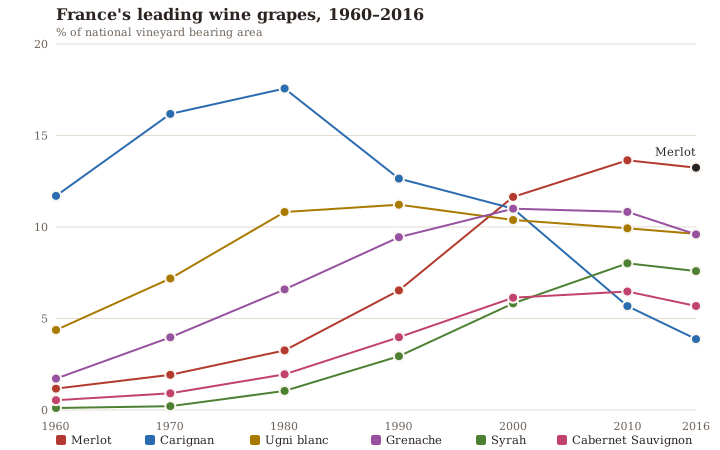
In 1960 France's single biggest variety was Carignan (entered in the database under its Spanish name, Mazuelo), which peaked at 17.6% of the national bearing area in 1980, with Ugni blanc and Grenache also prominent. By 2016 the ranking had been overturned: Merlot was France's number-one grape, at 13.2% of the national bearing area. Over the same span the country's total bearing area shrank from about 1.45 million hectares in 1960 to about 820,000 hectares in 2016 — a vineyard both smaller and differently planted.
The same data told as a race reads even more clearly. Follow any line: every crossing is a variety overtaking another in the national ranking.
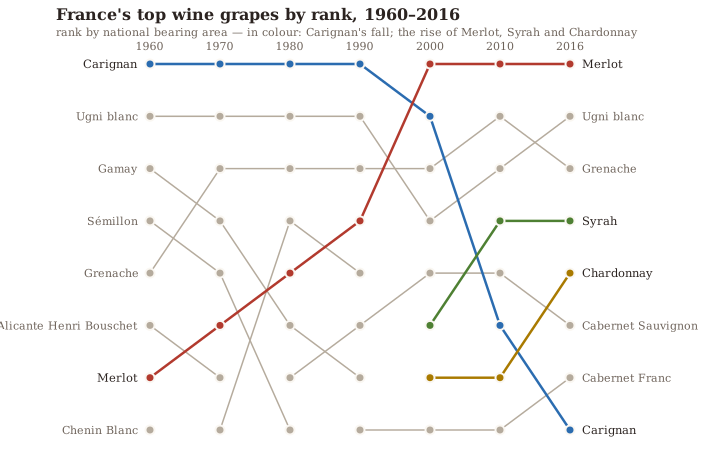
One caution is essential, and the chart makes it honestly: this series is France-wide, not Bordeaux. Carignan's reign was a story of the Languedoc, the vast southern vineyard, not of the Gironde. But the endpoint is a Bordeaux story. Merlot climbed to the top of the national ranking because Merlot's home is the Bordeaux right bank — Fronsac, Saint-Émilion, Pomerol and their neighbours — where it is the dominant grape. When Merlot became France's most planted variety, it was Bordeaux's grape that had won.
The Gironde today
For the region itself, modern figures confirm just how far the palette has narrowed and reddened.
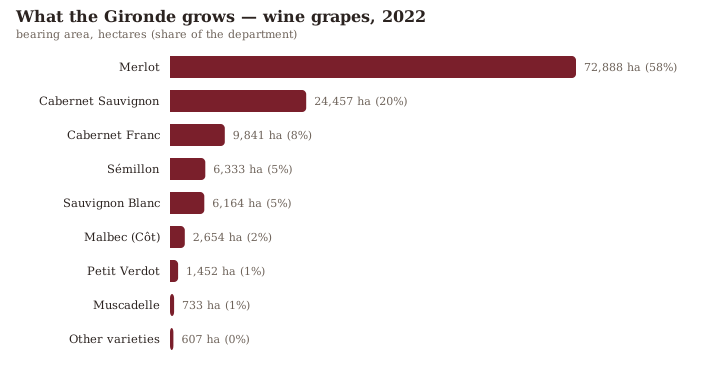
In 2022 the Gironde's bearing area breaks down as Merlot 58.3%, Cabernet Sauvignon 19.5%, Cabernet Franc 7.9%, Sémillon 5.1%, Sauvignon blanc 4.9%, Malbec/Côt 2.1%, Petit Verdot 1.2% and Muscadelle 0.6%. Read together, the reds account for roughly 87 to 89% of the vineyard: modern Bordeaux is, overwhelmingly, a red-wine region, and a Merlot-led one.
That balance carries a historical irony. Large parts of the Gironde once grew mostly white grapes. In the seventeenth and eighteenth centuries Dutch demand reshaped the vineyard around white wine — simple whites for distillation into brandy, and the sweet whites that made the region's early quality reputation — a transformation told in The Dutch Revolution in Bordeaux Wine. The white share of the vineyard was once far higher than the roughly one wine in ten it represents today. (How much higher, and where exactly, the sources do not let us quantify with confidence — the point is the direction of change, not a number.) The near-total dominance of red grapes is a recent condition, not an eternal one.
Climate and the future
The list may be about to change again. In 2021 the Bordeaux appellations authorised a set of new heat-adapted grape varieties for use in their wines — among them Touriga Nacional, a grape of the warm Douro — as a response to a warming climate. It is best described for what it is: a recent piece of regulatory experimentation, adopted in small, capped proportions and still being tested in the vineyard and the cellar, not a settled new order. Whether these varieties become a lasting part of the Bordeaux palette or remain a footnote is not yet knowable. But the mere fact of the decision closes the circle opened by Pliny. The vineyard began with a grape chosen because it could take the Atlantic cold; two thousand years later, it is choosing grapes that can take the heat. The names on the list keep changing. The logic — plant what the climate and the market will bear — is as old as Biturica.
Sources
- Pliny the Elder, Natural History, Book XIV
- Kym Anderson & Signe Nelgen, Database of Regional, National and Global Winegrape Bearing Areas by Variety (Wine Economics Research Centre, University of Adelaide)
- Roger Dion, Histoire de la vigne et du vin en France des origines au XIXe siècle (1959; CNRS Éditions, 2010)
- Gilbert Garrier, Le Phylloxéra — une guerre de trente ans, 1870–1900 (Albin Michel, 1989, ISBN 2-226-03879-5)