The Middle Ages
The English Centuries (1152–1453): What the Eleanor Story Leaves Out
Eleanor's 1152 wedding gets the credit, but Bordeaux's medieval wine boom was a 13th-century trade story — from the fall of La Rochelle to the 1308–09 record.
Every popular history of Bordeaux tells the same story. In 1152, Eleanor of Aquitaine married Henry Plantagenet; two years later he was crowned King of England, and her vast duchy — Bordeaux included — passed under the English crown. From that wedding, the story goes, flowed three centuries of claret. It is a good story, and the dates are right. But as a piece of wine history it is misleading in the way that matters most: it gets the timing of Bordeaux's rise wrong by about seventy years. The scholars who built the field — Roger Dion, Yves Renouard, Margery K. James — are unanimous that the decisive growth of the Bordeaux vineyard was a 13th-century commercial phenomenon, not a 12th-century dynastic one. The wedding set the political frame. The wine boom came later, and for different reasons.
A wedding, not a wine boom
The marriage of 1152 was a political earthquake. When Henry became Henry II of England in 1154, his continental possessions dwarfed those of the French king, and Aquitaine would remain attached to the English crown — through inheritance, war and treaty — for the next three hundred years. That is the frame within which everything else happened, and no serious account dismisses it.
But a market is not created by a signature. In the first decades of the Plantagenet connection, the wines that England drank from western France came principally from further north: La Rochelle and the vineyards of Aunis and Saintonge, closer to the sea lanes and already organised for export, preceded Bordeaux as the great Atlantic wine port. Roger Dion, whose Histoire de la vigne et du vin en France (1959) remains the foundation of French wine historiography, insisted on this sequence. In his account, Bordeaux in 1152 was not yet a vineyard of European consequence; it became one because of what happened in the following century.
1224: the fall of La Rochelle
The pivot came in 1224, when Louis VIII of France took La Rochelle. At a stroke, England's principal wine port on the Atlantic passed to its enemy — and Bordeaux, which had stayed loyal to the Plantagenets, became the privileged port of the Anglo-Gascon trade.
This, for Dion, is where the real history of medieval Bordeaux begins. Two forces converged on the city in the 13th century. From the sea came the maturing of Atlantic navigation: regular bulk shipping made it practical to move a heavy, low-value-per-weight commodity like wine over long distances. From the north came demand: England, Flanders and the northern towns, prosperous and thirsty, lay beyond the climatic limit of reliable wine-growing and had to import. Bordeaux sat exactly where those forces met — a defensible river port, backed by a huge wine-producing hinterland, with a sovereign on the other end of the sea lane. The vineyard expanded to meet the market. Dion drew from this a conclusion that still structures the scholarly debate: Bordeaux's greatness was a social and commercial fact before it was a geological one.
How the trade actually worked
The mechanics of this commerce were reconstructed in detail by Yves Renouard, whose 1959 article on "le grand commerce des vins de Gascogne" remains the classic account on the French side. Its rhythm was seasonal. After the harvest, the autumn wine fleet gathered in the Gironde — merchant ships, many of them English, loading the new vintage for Bristol, Southampton, London and the northern ports before the winter seas closed in. Medieval wine did not keep; the new wine of the current vintage was the prize, and speed to market was everything.
Around that annual pulse, Bordeaux built a formidable commercial machine. Gascon merchants and shipmasters worked the route in both directions, and the city's burghers used their loyalty to the English crown to extract privileges. The most consequential was the privilège des vins: Bordeaux's merchants claimed from 1241 the right to sell their own wines ahead of those of the interior, and in 1373 Edward III formalised the arrangement — wines of the Haut-Pays, the upriver country along the Garonne and Dordogne, could not be brought down to Bordeaux before Christmas. Since the great fleet sailed in autumn, this handed Bordeaux's own vineyard an effective monopoly on the English market's most valuable window. The privilege, remarkably, survived until the French Revolution.
The peak: what the customs registers show
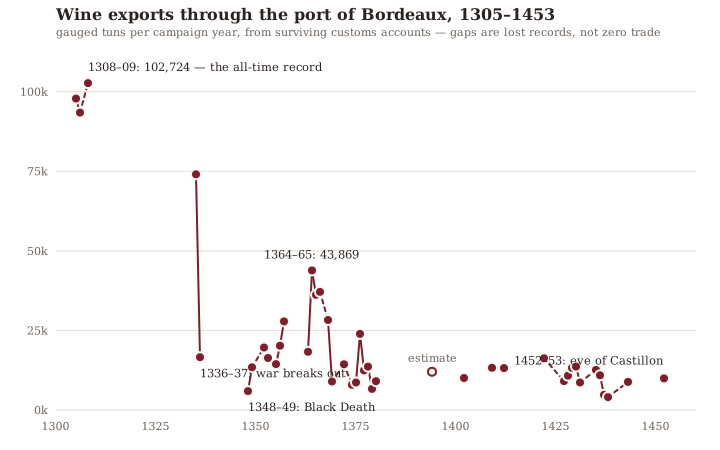
For the early 14th century, this trade can be counted, not just described. The registers of the Grande Coutume de Bordeaux — the export duty levied at the port — survive in series from 1305, alongside the English Exchequer accounts; Margery K. James's 1951 article in the Economic History Review turned them into the statistical backbone of the whole field.
The figures at the peak are startling. In 1306–07, 93,452 tonneaux of wine passed through the port; in 1308–09 the registers record 102,724 tonneaux, the all-time record — Sandrine Lavaud, the standing authority on medieval Bordeaux, calls it the apogee of the port until the modern era. Two caveats belong next to those numbers wherever they are quoted. First, the medieval tonneau was a cask of roughly 800–900 litres, so the record year represents something on the order of 850,000 hectolitres — an enormous volume by any pre-industrial standard. Second, these are figures for port throughput, not vineyard production: they include the transit wines of the Haut-Pays passing through Bordeaux, not merely the yield of the Bordelais itself. They measure the size of the trade, which is precisely the point.
War, contraction, Castillon
The peak did not last. Margery James's series shows the 14th-century trade as a story of violent fluctuation, and the outbreak of the Hundred Years War in 1337 turned Gascony into a theatre of war. Campaigning devastated the upriver vineyards, convoys needed escort, and the export trade contracted sharply from its early-century heights, never to recover them under English rule.
The end came on 17 July 1453 at Castillon, east of Saint-Émilion, where the French artillery destroyed the Anglo-Gascon army and John Talbot, Earl of Shrewsbury, was killed. Bordeaux surrendered that October. After three centuries, English Gascony was finished.
What the end of the era changed
The consequences were commercial as much as political. Bordeaux lost its privileged access to what had been, for two hundred years, its dominant customer; English merchants now traded in what was foreign territory, and the easy annual rhythm of the autumn fleet was broken. Yet the structures the English centuries had built proved durable. The vineyard itself, the merchant city, the privilège des vins — confirmed by the French kings and kept until the Revolution — all survived the change of sovereign. What Bordeaux needed was a new great customer, and in the following centuries it found one: the Dutch, whose demand would reshape the vineyard as profoundly as England's once had.
That is the real shape of the English centuries. The wedding of 1152 opened a door; it was the fall of La Rochelle in 1224, Atlantic shipping, northern demand and the machinery of privilege that pushed Bordeaux through it — all the way to the hundred-thousand-cask year of 1308–09 that no one would see again for centuries.
Sources
- Roger Dion, Histoire de la vigne et du vin en France des origines au XIXe siècle (1959) — reviewed by Philippe Wolff, Cahiers de civilisation médiévale (1962)
- Sandrine Lavaud, chapter in Vins et vignobles. Les itinéraires de la qualité (OpenEdition Books)
- Sandrine Lavaud, "Vignobles et vins d'Aquitaine au Moyen Âge", Territoires du vin n°5 (2013, CC BY 4.0)
- Margery K. James, "The Fluctuations of the Anglo-Gascon Wine Trade during the Fourteenth Century", Economic History Review (1951)
- Yves Renouard, "Le grand commerce des vins de Gascogne au Moyen Âge", Revue historique (1959)