Themes
The Economics of Bordeaux Wine in Charts (1305–2024)
Seven centuries of wine economics in verified numbers — medieval export records, the phylloxera collapse, the consumption crash and the export pivot.
The history of Bordeaux wine is usually told in stories — kings, merchants, plagues, classifications. But an unusual amount of it can also be told in numbers, because Bordeaux happens to sit at the junction of two exceptional statistical traditions. At one end, a medieval customs register that starts in 1305, among the richest trade series of the European Middle Ages. At the other, the modern economists' long series — production, consumption, trade and vineyard area for France since the nineteenth century, assembled by Kym Anderson and Vicente Pinilla at the University of Adelaide. This article is a guided tour through those numbers. Each section is anchored on one chart or one verified figure, and together they trace a single arc: a wine economy built by export in the Middle Ages, turned inward toward a thirsty home market in the nineteenth and twentieth centuries, and forced back out into the world as that home market melted away.
The medieval record
The starting point is not a chart but an archive. From 1305, the accounts of the Grande Coutume de Bordeaux — the duty levied on wine passing through the port — survive in series, preserved with the English Exchequer records because Bordeaux then belonged to the kings of England. The economic historian Margery K. James built the canonical export statistics from them in a 1951 article that remains the foundation of the field.
The headline figures are startling. In the fiscal year 1306–07, 93,452 tonneaux of wine were exported through Bordeaux; in 1308–09 the port recorded 102,724 tonneaux, a figure Sandrine Lavaud, the leading historian of medieval Bordeaux, describes as the apogee of the port — a level not seen again until the modern era. A medieval tonneau held roughly 800 to 900 litres, so the 1308–09 record represents on the order of 800,000 hectolitres of wine in a single year, moved in wooden ships.
Two caveats keep these numbers honest. The tonneau's capacity is approximate, so any conversion to modern units is an estimate. More importantly, these are port throughput figures: they include wine from the Haut-Pays — the river basins upstream of Bordeaux — transiting through the port, not just the production of the Bordeaux vineyard itself. What the Grande Coutume measures is Bordeaux as a trading machine, and on that measure the machine was running at full capacity at the start of the fourteenth century. It is worth pausing on how unusual this is: for most European regions, quantitative economic history begins in the nineteenth century, or the eighteenth at best. Bordeaux can put a hard number on its export trade seven hundred years ago — which is why the medieval record deserves a place at the head of any tour of the region's economics, even without a chart to hang it on.
Production, 1835–2024
The modern statistical record picks up in the nineteenth century, and it opens on a drama.
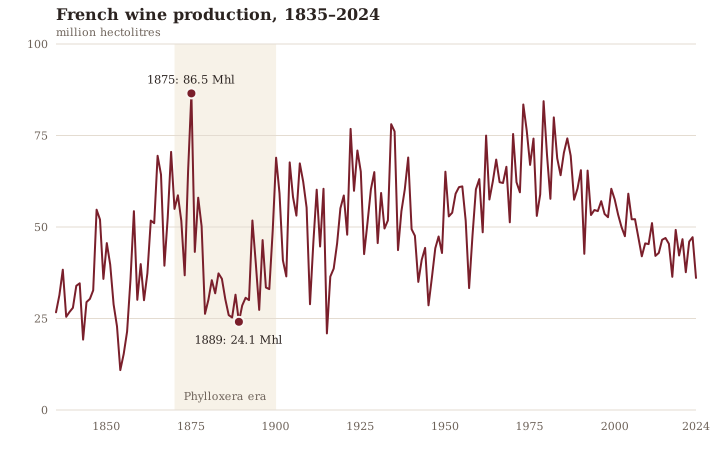
French production reached 86.5 million hectolitres in 1875 — the all-time peak, harvested by a vineyard at its maximum extent, just as the phylloxera aphid was beginning to kill it from the roots. Fourteen years later, in 1889, production had collapsed to 24.1 million hectolitres: less than a third of the peak, the deepest trough of the phylloxera crisis. The recovery that followed, on grafted American rootstock, rebuilt volumes but never re-established the 1875 world. James Simpson's study of French wine markets between 1870 and 1911 shows why the collapse was so destabilizing: scarcity drove prices up, high prices drew in imports and adulteration, and when the replanted vines came back into bearing the market tipped into glut. The twentieth century then plays out on the chart as a slow descent with violent interruptions, down to 36.1 million hectolitres in 2024 — a harvest smaller than any the 1870s would have recognized as normal.
The consumption collapse
If one chart explains the modern French wine economy, it is this one.
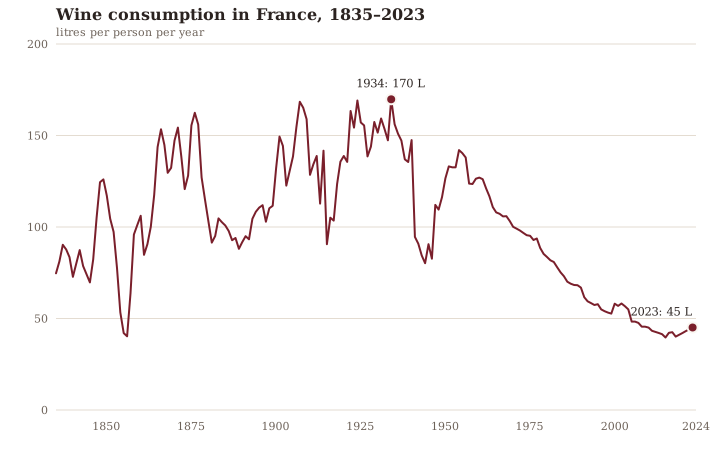
In 1934, the average French person drank 170 litres of wine a year — nearly half a litre a day, across the entire population. In 2023 the figure was 45 litres. That is not a dip or a cycle; it is the disappearance of almost three quarters of the domestic market over three generations, as wine moved from daily staple to occasional pleasure. Every structural fact of the modern French wine economy — chronic overcapacity, price pressure at the entry level, the strategic obsession with quality and with foreign buyers — sits downstream of this single line. The producers of ordinary daily wine lost their customer; the producers of wine people choose to drink, rather than drink by default, inherited the market that remained.
The export pivot
The industry's answer to the vanishing home market is visible in the next chart: it went abroad.
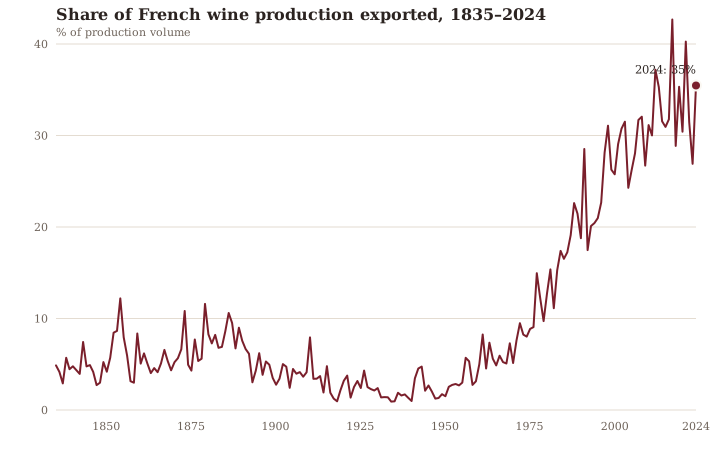
In 1900, France exported under 3 per cent of its wine production; the rest was drunk at home. As late as 1960 the share was only around 5 per cent. By 2024 it had reached 35 per cent. In little more than half a century, an industry that had been overwhelmingly domestic became one of the world's great exporters — a reversal of the nineteenth- and twentieth-century inward turn, and, seen from Bordeaux, something like a return to form. The port that shipped a hundred thousand tonneaux to England in 1308 spent the industrial era selling mostly to France; the export pivot restored the outward orientation that had built the region in the first place.
The shrinking vineyard
The final series measures the land itself.
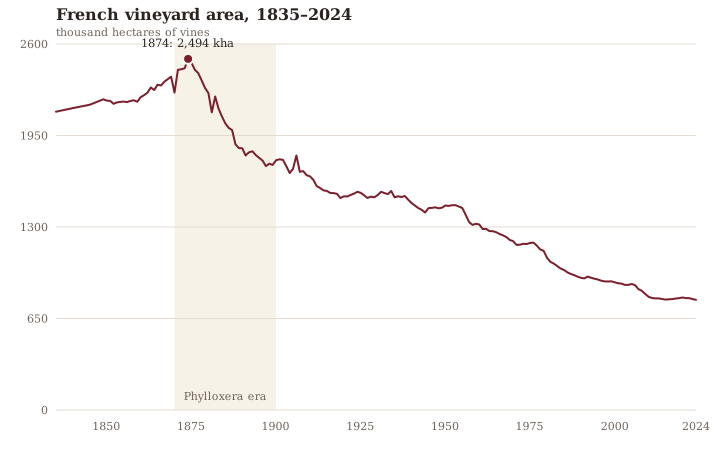
The French vineyard reached its maximum extent of 2,494 thousand hectares in 1874, on the eve of the phylloxera collapse. By 2020 it covered 799 thousand hectares — less than a third of the peak. The contraction has never really stopped: phylloxera removed vines that were never replanted, the consumption collapse made vast areas of ordinary-wine vineyard uneconomic, and successive waves of subsidized grubbing-up removed more. Bordeaux is living the latest chapter now. Faced with unsold generic wine and falling demand, the Gironde has in recent years run organized arrachage (uprooting) campaigns, paying growers to remove vines permanently — a painful adjustment, but one the long series frames as the continuation of a 150-year-old trend rather than a sudden anomaly.
What the long series say about Bordeaux
Read together, the series tell a story that the historian Roger Dion would have recognized: markets made this region. Dion's central argument — that the greatness of French vineyards is a social and commercial fact before it is a geological one — is what the numbers act out across seven centuries. The medieval export machine of the Grande Coutume years, the nineteenth-century boom and phylloxera bust, the slow death of the domestic mass market and the flight to export: at every turn, it is demand — English, Dutch, French, global — that shapes what the vineyard is and how large it can afford to be.
One caveat must be stated plainly. Apart from the medieval port records, every series on this page is national — France as a whole, not the Gironde. Bordeaux's own trajectory tracks the national one in broad shape but differs in detail, and nothing here should be read as a Gironde-specific measurement. The full national series behind each chart — production, consumption, trade and vine area, with the Anderson & Pinilla citation and documentation — can be downloaded as CSV files on our data page.
Sources
- Anderson & Pinilla, Annual Database of Global Wine Markets, University of Adelaide
- Sandrine Lavaud, Vignobles et vins d'Aquitaine au Moyen Âge (and related work on medieval Bordeaux)
- Margery K. James, The Fluctuations of the Anglo-Gascon Wine Trade during the Fourteenth Century, Economic History Review, 1951 (DOI 10.1111/j.1468-0289.1951.tb00607.x)
- James Simpson, Phylloxera, Price Volatility and Institutional Innovation in France's Domestic Wine Markets, 1870–1911 (IFCS WP wh044602, 2004)
- Roger Dion, Histoire de la vigne et du vin en France, des origines au XIXe siècle (CNRS Éditions)